
Derived from the ROAR Mindset podcast conversation
Perception Gap in Collaborative Innovation
Why Teams That Agree Still Fail
Four teams. One project. The same words in every meeting. Six months later, they would have built four different things.
This is not a fictional scenario. It's something I experienced directly while leading a cross-functional initiative at Intel involving battery performance optimization. Everyone was aligned, or appeared to be: everyone used the same technical terms, attended the same reviews, nodded at the same milestones.
But when I slowed down and asked each team what those terms actually meant to them, four distinct interpretations emerged.
“They all said the same acronym, the same name. But they all meant different things. Six months from now, what were we going to end up with?”
I spent two full months establishing a shared definition before a single line of work was executed. At the time, that may have felt like a delay. In retrospect, it was the most productive investment made in the entire initiative.
What the Perception Gap Actually Is
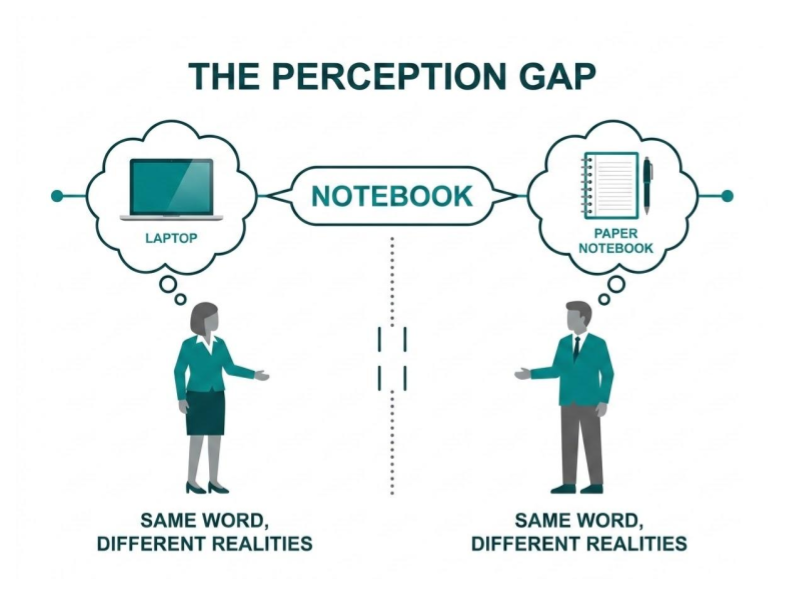
The Perception Gap is not disagreement. Disagreement is visible and usually addressed because it creates obvious friction. The Perception Gap is the misalignment that lives beneath agreement, where two people use identical language to describe different realities.
A lighter illustration: a colleague in Malaysia lost his “notebook.” Security teams searched everywhere for a laptop. He meant a paper notebook with a spiral binding. A full day was spent searching for a device that was sitting quietly in a bag.
“The notebook wasn't a laptop. But we were all engineers at Intel. Of course we assumed laptop. How much time got wasted on a one-word misunderstanding?”
How Often Does This Actually Happen?
My estimate, formed over decades of leading global technical teams: more than 50% of workplace conflict traces to misunderstanding rather than genuine disagreement, and the pattern isn't limited to work. The challenge is especially acute in the environments global technology organizations operate in: across cultures, languages, disciplines, time zones, and organizational levels. The words travel, but the meaning doesn't.
Why Standard Approaches Miss It
Most communication frameworks are designed to address disagreement, not misunderstanding. But you cannot debate your way out of a Perception Gap, because the gap doesn't feel like a disagreement. Instead, it feels like agreement. The conflict only appears downstream, once misaligned interpretation has already been translated into misaligned work.
“The biggest problem is misunderstanding. They all say the same thing but interpret it differently. Before I let the work begin, we all have to mean the same thing by the words we're using.”
The Technique: Clicking Down
I call my method “clicking down,” which is a systematic process of moving from apparent agreement to verified understanding, layer by layer, starting from where everyone agrees and moving incrementally toward the complex.
The technique produces three things: a visible, written shared definition; the discovery of what people actually fear beneath their stated resistance; and a foundation for sustainable alignment that doesn't require rehashing assumptions at every turn.
What Closing the Gap Makes Possible
Teams that close the Perception Gap consistently produce work faster — not because they work harder, but because they stop doing the wrong work. They spend less time in conflict resolution because the conflicts that remain are about real differences, not linguistic accidents.
Closing the Perception Gap creates the conditions for collaborative innovation: the environment where diverse perspectives produce outcomes no single perspective could reach alone. Collaboration without shared understanding is theater. Innovation without diverse understanding is incremental. When both exist together, something different becomes possible.
Three questions to surface a Perception Gap: “What does this term mean to you specifically?” “If we build exactly what we agreed to, what will it look like?” and “What would have to go wrong for you to feel this was a mistake?”
The next time your team walks out of a meeting feeling aligned, pause and ask one of those questions. You may find you're closer than you think. Or you may find that two months of shared definition work just saved you six months of misaligned execution.
Ahmed Omer is the Founding President of Converging Fractal, a strategic advisory firm specializing in collaborative innovation architecture for global technology organizations. His methodology, the Converging Fractal Operating System (CFOS™), helps distributed teams close Perception Gaps, eliminate decision friction, and build the conditions for sustained collaborative performance. Learn more at convergingfractal.com.